Local detail
What You Pay
We don't have a flat number to give you here, because what a door costs depends on whether it's hung in a detached garage with its own frame or bolted into an attached garage that shares a wall with the house. Framingham's housing stock runs 1938 to 1993, median build year 1968, which means a lot of these garages were framed with whatever lumber and hardware was standard for that decade - not what's standard now. A detached garage built in the 1940s or 50s often needs a header reinforced before a new door goes in at all, because the opening was never sized for a modern insulated panel. An attached garage from the 1970s usually has a steel frame that's closer to today's spec, so the door itself is the only variable. We'll tell you straight if your opening needs carpentry work before we quote the door - that's not us padding the job, that's the house telling us what it needs.
The area
What to Check
Start at the top track bracket. On a detached garage, that bracket is lag-bolted into a stud that's been taking the full swing of outdoor temperature for 50-plus years in some cases, given the 1938-1993 build range across this area. Check it for play - if the bracket wiggles when the door's at the top, the wood around it has dried and shrunk. On an attached garage, the shared wall usually holds heat better, so that bracket wears less, but the service door between garage and house (if there is one) is worth a look for weatherstripping, since a loose seal there pulls garage-level cold right into the house. Also check the bottom panel on any door facing the driveway side exposed to full weather - on a detached structure with no overhang, that panel takes rain and snow directly and rusts or rots faster than a panel tucked under an attached garage's roofline.
What we find
The Situation
Framingham and the towns around it - Ashland, Southborough, Natick, Sudbury, Wayland, out to Marlborough and Hopkinton - share the same housing era: mostly 1960s and 70s construction across the dozens of neighborhoods in this service area. That means a huge share of the doors we get called on are original or first-replacement doors on hardware sized for a house built before double-car garages were standard. Detached garages from that era were often added later, as a separate structure, with a lighter-duty track system than what came with the house. Attached garages built as part of the original structure usually got the builder-grade door and opener bracket that was standard at the time, which by now is 50-plus years old if the owner hasn't touched it. Either way, the age of the structure tells you more about what's likely to fail than the brand on the door ever will.
How we work
What the Weather Here Does to It
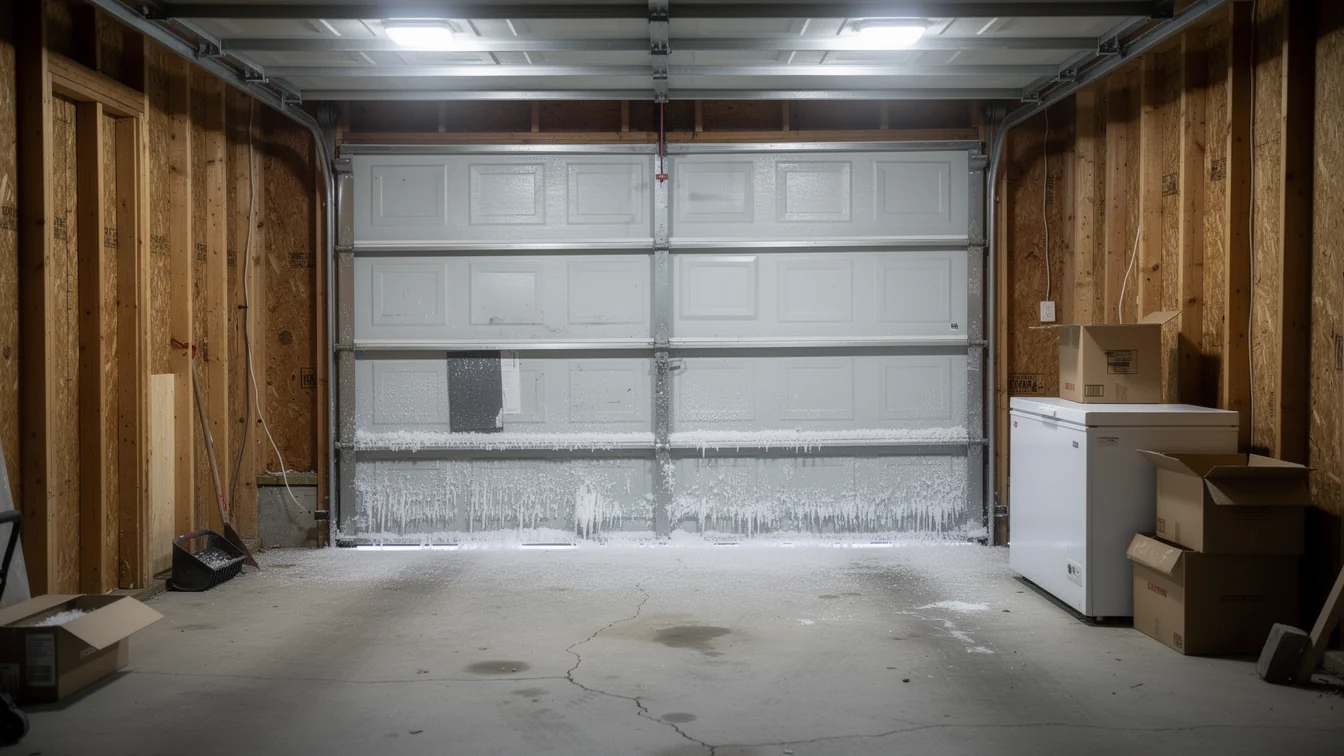
This is a cold-climate service area, and that matters differently depending on whether your garage is attached or standalone. A detached garage has no shared wall pulling any ambient heat from the house, so its slab and door hardware swing through the full range of a Massachusetts winter - steel contracts, torsion springs lose a little tension, and nylon rollers stiffen until the first warm day. An attached garage runs a few degrees warmer most winters because it borders heated living space, which is often why an attached door's springs outlast a detached door's by a noticeable margin even on the same street. Either way, cold-soaked steel is more likely to crack a panel on impact, so a kid's basketball or a bumped car does more damage in January than in July. We can't change what your garage borders - we can tell you it's worth knowing which kind you have before you guess at why a door's acting up.
Talk to a local pro
Garage door trouble in Framingham?
Same-day service with honest, upfront quotes.